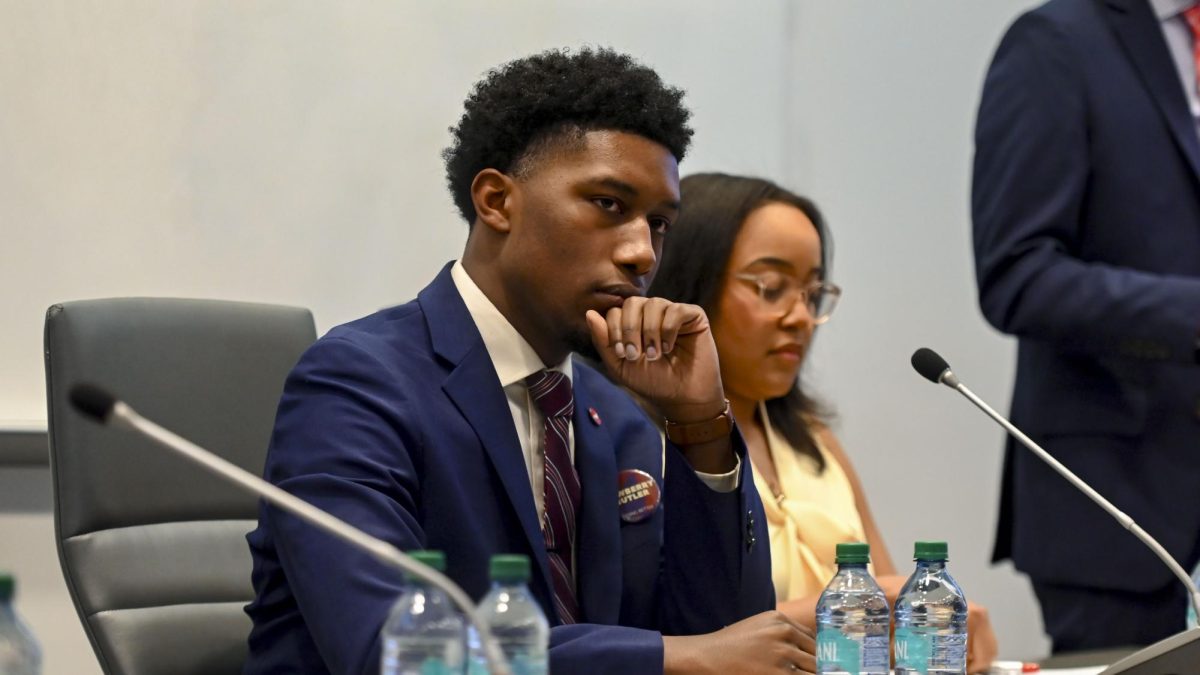
President and Vice President Candidates Taquan Dewberry and Ava Butler were the respondents in four violation hearings held on March 8, 2026, at 12:15 p.m that ended in disqualification. All rules referenced in this article can be viewed in the Elections Handbook.
Board of Elections vs. Dewberry & Butler
The Nubian Message was not present for this hearing and has limited information.
The NC State Student Government Board of Elections petitioned for the first hearing for violations against § 4-1.6. Endorsements and Affiliations restrictions. This section of the elections handbook requires student organizations to endorse candidates through established procedures and with equal opportunity to all candidates.
The Board said NC State’s Higher Education Masters Association (HEMA) had endorsed Dewberry and Butler without following § 4-1.6. guidelines. The Board also said that Dewberry-Butler campaign materials were posted to HEMA’s Instagram prior to his official endorsement.
In closed session, the Board determined that the Dewberry-Butler campaign followed official endorsement channels, even if they did break rules in posting campaign materials. The Board motioned to issue Dewberry and Butler a notification rather than a warning, which would have counted towards disqualification.
Trask vs. Dewberry & Butler
President Candidate Knox Trask petitioned for the second hearing for the violations against § 5-1.2. Spending Limits, § 5-1.4. Expense Report Requirements, § 5-1.6. Expense Reporting Standards and Documentation and § 5-1.10. Penalties Concerning Expenses.
Trask alleged that the Dewberry-Butler campaign underreported the costs of campaign pins. In the Elections Handbook, it says that, “Candidates must report all donated or discounted goods and services at their fair market value.”
This section of the rule heads the Trask violation petition. Dewberry-Butler reported the total cost of the pins as $3.75. Trask claimed that the fair-market value of the pins, made by Tin’s Pins, is $375.00 and cited Tin’s Pins’ prices available on their Instagram. Trask claimed this would put them over the allotted campaign expense amount of $400, which would result in disqualification.
Dewberry responded that Tin’s Pins provided free pins because her graphic designs and materials were not used. Dewberry said all materials were sourced freely from the NC State Library and are open to the public. Dewberry argued that since these pins could be made by any other running candidate or student for free, the fair market value is free.
Dewberry said the documented $3.75 was to account for WolfPrint color printing, which they did not pay for.
Trask’s closing statement restated his original statement of the pins’ fair market value being $375, and Dewberry-Butler excluded a fair market valuation from their report.
Dewberry gave the following closing statement: “The argument relies on false assumptions about the source and cause of the pins. The vendor themselves confirmed that the pens were provided free of charge. They’re made using the NC State maker space equipment, which all students pay into with their student fees. That is the fair market value and is free to all NC State students.”
A motion for disqualification was passed with a 4-2 vote “because the failure to report the fair-market value of these pins materially altered the campaign’s reported expenditures and concealed a donation that would place the campaign above the statutory spending limit, the Board finds the violation to be both material and intentional … ”
Trask vs. Dewberry & Butler
Trask petitioned for the third hearing for violations against § 4-1.7. Candidate Conduct and Campaign Standards of the Elections Handbook.
Trask claimed that “based on direct observation and publicly available pricing information,” the Dewberry-Butler campaign “distributed free food and beverages to students at a campaign table during the election period.”
Trask’s claim hinged on the aforementioned rule, which says “Giveaways, raffles, or food items may not be used to influence voters. Only symbolic items under $1.00 value (e.g., stickers) are permitted.”
Trask claimed that Lucky Energy 16oz drinks, Alani Nu Mini Energy Drinks and chips were given to individuals who approached their campaign table in Talley, which greatly exceeded the $1 value permitted. Additionally, thatthe rates of tabling are approximately $130 for non-university groups.
Dewberry’s defense entailed that they did not distribute food and beverages, but that the refreshments referenced in Trask’s claim were provided by a private student housing company, HUB Raleigh, that was tabling. Dewberry said, “At no time were students asked to pledge support for the campaign, commit to vote for the campaign or interact with campaign representatives in order to access refreshments.”
Dewberry provided a statement from HUB Raleigh that said, “No promotion of materials used in our marketing included promotion of the Dewberry-Butler campaign.”
Dewberry outlined their campaign had no affiliation with the HUB Raleigh for tabling, other than the fact that they knew the person who would be tabling for the HUB Raleigh.
Dewberry brought a witness to confirm this. Elijah Lott, a first-year student studying civil engineering and economics and HUB Raleigh leasing and marketing associate, said he was there tabling for the event, and was promoting HUB Raleigh and handing out items branded with their logo.
The voting members of the Board of Elections were tied on how to distinguish the difference between the campaigning efforts of Dewberry-Butler and the marketing efforts of the HUB Raleigh.
Dewberry ensured that he was only conversing with students, and his campaign and the marketing of the HUB Raleigh were two separate occurrences.
The violation of the rule was dismissed with a 5-2 vote due to “insufficient evidence that the Dewberry-Butler campaign coordinated with the HUB Raleigh or was responsible for the distribution of food or other items of value at the event.”
Jacob Smith vs. Dewberry & Butler
Jacob Smith, a Technician staff writer whose work is temporarily suspended for the duration of the student government spring election campaign period and a fourth-year political science major, petitioned the fourth and final hearing regarding rules § 4-1.7. Candidate Conduct and Campaign Standards.
Similar to the previous hearing, the claim hinged on the rule that says, “Giveaways, raffles, or food items may not be used to influence voters. Only symbolic items under $1.00 value (e.g., stickers) are permitted.”
Jacob Smith claimed the Dewberry-Butler campaign utilized HUB Raleigh’s hosted BBQ event on Friday, March 6. His claim references Dewberry-Butler’s Instagram post advertising the event.
“This post was posted on [Student Body President] candidate Taquan Dewberry’s personal Instagram account story (Exhibit 2) with the message “Free Food and Dewberry-Butler Come Join Us,” said Smith.
Dewberry’s defense highlighted the event was not a campaign-hosted effort, nor did they provide the food that was distributed. They claimed that, to them, their Instagram post verbiage was clear; it was not a collaboration, but simply that they would be at this event to converse with students.
Dewberry provided a statement from the HUB Raleigh that said the event was not intended for the promotion of the Dewberry-Butler campaign; however, an invitation from the HUB Raleigh was extended to Dewberry-Butler.
Dewberry said, “I was informed by a member of the student government that the Eddinger-Rivas campaign was monitoring the event with the intent that they would file a violation.”
Dewberry continued, “It is extremely disheartening and deeply disappointing to know that another campaign intentionally and not once did they deny that they did it …The only time a person who was not already supporting our campaign shared a conversation with me about the campaign was when they were working for the Eddinger-Rivas campaign to gather the information presented today.”
In an interview with The Nubian Message, Dewberry said the person who spoke to him from the Eddinger-Rivas campaign also lied about their name.
Smith said he did not know about the deception that occurred.
A motion for disqualification was passed with a unanimous 6-0 vote due to the violation in “three primary ways, including promoting the event, requesting that attendees tag and follow the Dewberry-Butler campaign on social media while receiving free food and beverages, and accepting a direct invitation from HUB Raleigh to campaign at the event.”
Violation of Open Meeting Law
The Student Government Board of Elections went into closed session for deliberation and vote, which is a violation of the Open Meeting Law. NC State’s Office of General Counsel website outlines the public body criteria to go into closed session. This failure to comply can result in “declared actions taken during the meeting to be null and void.”
The Dewberry-Butler ticket is looking to appeal the decision. Voting takes place on March 9 and 10, and the Dewberry-Butler candidates will still be on the voting ballot with a note of their disqualification.