
Editor’s note: This report was produced in collaboration with Technician.
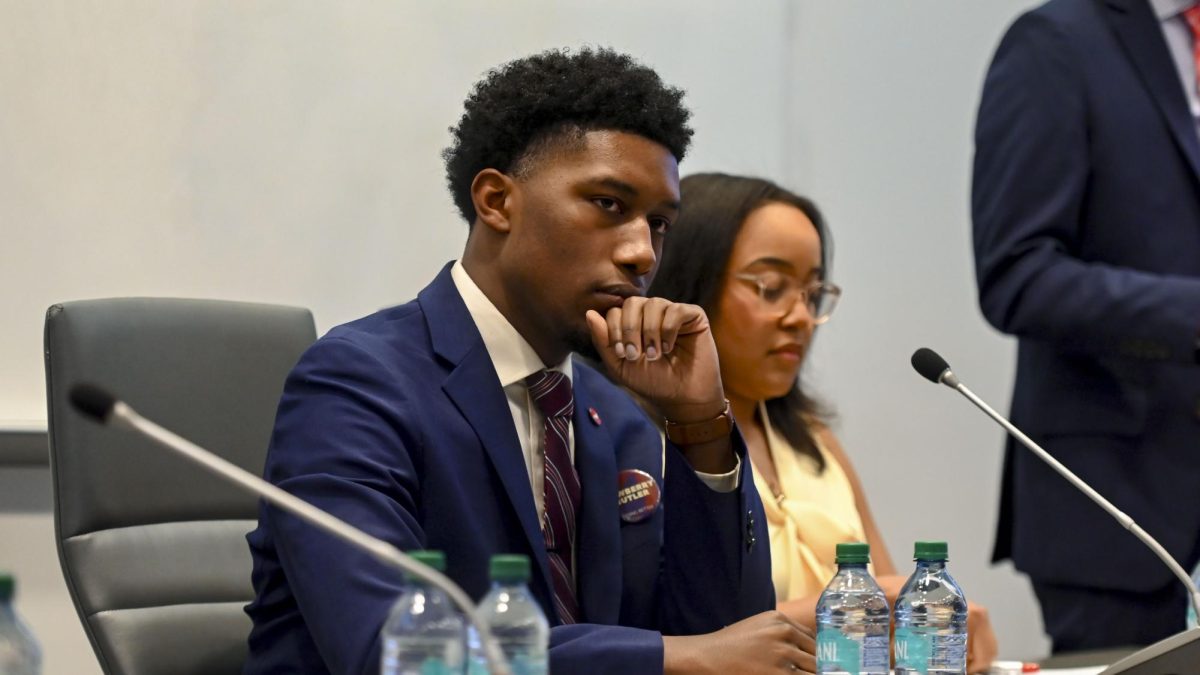
The Dewberry-Butler campaign appealed their multiple disqualifications from the student body president and vice president race to the Special Review Committee Thursday night, following violation hearings held Sunday, March 8.
A Student Government advisor told Student Media and the public that results will be publicly available within 24 hours.
Violation of the Bribery Rule §4-1.7(e)
Chair of the Board of Elections Joseph Attanucci presented the board’s argument for disqualifying the Dewberry-Butler campaign following an event hosted by HUB Raleigh, which the board stated constitutes bribery per rule §4-1.7 in the Student Government Elections Handbook.
“[The board’s] task during the violation hearing was therefore straightforward: to determine whether the Dewberry-Butler campaign used or promoted an event where food was issued to students and the campaign context intended to influence voters,” Attanucci said. “If that conduct occurred, the Election’s Handbook classified that violation as immediate disqualification.”
The board examined posts from Dewberry-Butler’s personal and campaign social media accounts regarding the HUB Raleigh event. Attanucci highlighted that the posts on the Dewberry-Butler accounts referred to the HUB Raleigh event as a “Doing Better BBQ” that used “graphics that were visually identical to the Deberry-Butler campaign’s existing brand.”
Attanucci said the board deduced that the event was promoted to students with campaign identity in mind, and according to the Elections Handbook’s definition for campaigning, the actions are considered a campaign promotion of an event.
Attanucci said the board also considered how the students became aware of the event and if campaigning occurred at the event. Through witness testimony from the petitioner’s evidence at the original violation hearing, the board said students became aware of the event through the Dewberry-Butler campaign, and that campaigning occurred due to individuals being “encouraged to follow, tag, repost and otherwise amplify the campaign promotions of the event.”
Dewberry and Butler claimed that the petitioners’ witnesses were in correspondence with two members of the Eddinger-Rivas campaign, another ticket for student body president and vice president, and reported back to the candidates. The witness was not a valid source, therefore not verified evidence of voter bribery, they said.
“Zach [Eddinger] and Alex [Rivas] ran into them right outside of the event, on that first street when they walked out,” Dewberry said. “These people were associated with the campaign, as admitted to by the campaign manager or spokesperson present at the event.”
Lastly, the board considered whether food was distributed and, if so, how it contributed to campaigning, ultimately concluding that the event did distribute food that influenced students to attend.
“Because the rule prohibits issuing food items to influence voters and classifies such conduct as an immediate disqualification violation, [it] shall result in immediate disqualification. The board determined that the violation met the criteria for that sanction,” Attanucci said.
Chief Justice Colin Carmichael opened up for questioning of the Board of Elections for committee members. Student Body President Isaac Carreno asked, “Do you believe that a reasonable student, viewing this post, would understand the event to be sponsored or endorsed by the Dewberry-Butler campaign?” and Attanucci responded, “I do.”
Student Senate President Naila Din asked what led the Board of Elections to believe there was a direct coordination with HUB Raleigh. Attanucci said the submitted evidence from the petitioners, particularly an email from Kendra Hooks, HUB Raleigh’s Development Senior Manager, indicated a personal invite extended to the Dewberry-Butler campaign.
Dewberry and Butler stated they appealed their case because the Board of Elections “misapplied the Election’s Handbook, relied on unsupported assumptions, [failure] to include room for biases and malicious intent behind accusations and reached conclusions inconsistent with the evidence presented.”
Dewberry and Butler argued they did not distribute food at the event, and the event was open to all students and candidates. If this decision were upheld, they said it would discourage voters and candidates alike from participating and engaging with Student Government, leaving a student body already lacking in civic participation on campus even more alienated from the student body.
They said no discussion of voting nor inducement occurred, which contested the Board of Elections’ reasoning for the disqualification decision.
“The affidavits describe food being present, campaign members speaking with students and personal opinions about fairness,” Butler said. “They do not claim that food was provided by the campaign, food was exchanged for votes, or access to food required campaign support. Therefore, the statements do not establish verified voter bribery.”
Dewberry and Butler believe this situation is a miscommunication, which warrants a notification or a warning at most. The campaign requested the board to either vacate the disqualification issued by the Board of Elections or lower the action to a notification or warning.
Violation of the Finance and Expense Reporting Article (§5-1)
In the second special hearing, Attanucci reexplained the board’s previous decision that Dewberry-Butler’s campaign underreported the value of donated campaign pins at $3.75 from @tins.pins, a student and friend of Dewberry.
Dewberry and Butler said $3.75 was used to pay for the paper on which the pins were printed, and they were made using Maker Space, which is free to all students. However, Attanucci said the Dewberry-Butler campaign failed to report the fair market value of the pins at $5 a piece, which is the price at which @tins.pins usually sells her products.
“These pins were not available to the general public at five cents, and they were available at five dollars,” Attanucci said.
In his appeal, Dewberry said there is a material difference between the campaign pins and @tins.pins’s commercial products, given that they used free Maker Space materials.
In a Letter to the Editor received by The Nubian Message, Tindra Tramontano, owner of @tins.pins, wrote, “I did not think it made sense to charge them for the pins since I did not need to purchase any of the supplies. All students are able to use the free supplies in the maker space for their hobbies and student organizations. When I sell products, I purchase my own supplies, including machines, software, and higher-quality buttons, which are factored into my prices.”
Dewberry said the Eddinger-Rivas also utilized the Maker Space in the creation of their campaign buttons and reported it as free in their expense report.
In a previous statement to Technician, Dewberry said that he had met with Attanucci before reporting to the board to receive guidance on reporting the expenses of the pins. Attanucci said what was discussed in that conversation was not binding.
“Candidates frequently seek informal guidance from the board during the course of a campaign, and board officers, including myself, routinely answer those questions in good faith in order to help candidates comply with the rules,” Attanucci said. “However, student body statutes explicitly address the legal effect of those conversations. The statute states that the board shall attempt to make decisions consistent with past practice where appropriate. However, it very clearly also provides that in no case shall the board be bound or otherwise defer to statements or pledges made by its officers, or candidates or other interested parties. Furthermore, such officer statements, including mine, shall not be considered mitigating indication in cases of violation of election rules.”
Meeting Overflow
The Special Review Committee meeting’s location was changed from the Student Governance Suite room 4251D to a conference room on the fifth floor of Talley the night before the meeting in an email sent to members of Student Government.
The new location was unable to accommodate all of the observers, leading to an overflow outside. Some students were refused entry in accordance with the fire code.
Technician was unable to enter the room for the first violation hearing.
Breanna Armas, a first-year studying criminology and political science, was one of nearly two dozen students waiting outside the conference room. She said she was a supporter of Dewberry’s campaign and came to show support and witness the hearing.
“I expected they would have it in a much bigger area because everybody got in there so quick and everybody else got in,” Armas said. “They were like, ‘Oh, you guys have to go.’”
Armas said she felt that the meeting should have been more accessible to the public due to the impact the decision could have on the student body.
“I mean, they’re running to be the student body president and vice president,” Armas said. “We’re students here. I feel like we should be able to hear their case.”
Quentin Clark, a third-year studying industrial engineering and another student who was waiting in the hall, said he felt as though the room’s space was small for the hearing, considering Dewberry’s supporters and the magnitude of the appeals.
“It’s unfortunate. I mean, it makes sense though, like from a capacity standpoint, but maybe it would be better if a lot of people can show up,” Clark said. “I feel like we’ve got some pretty big spaces here to accommodate everybody.”
This is a developing story.


