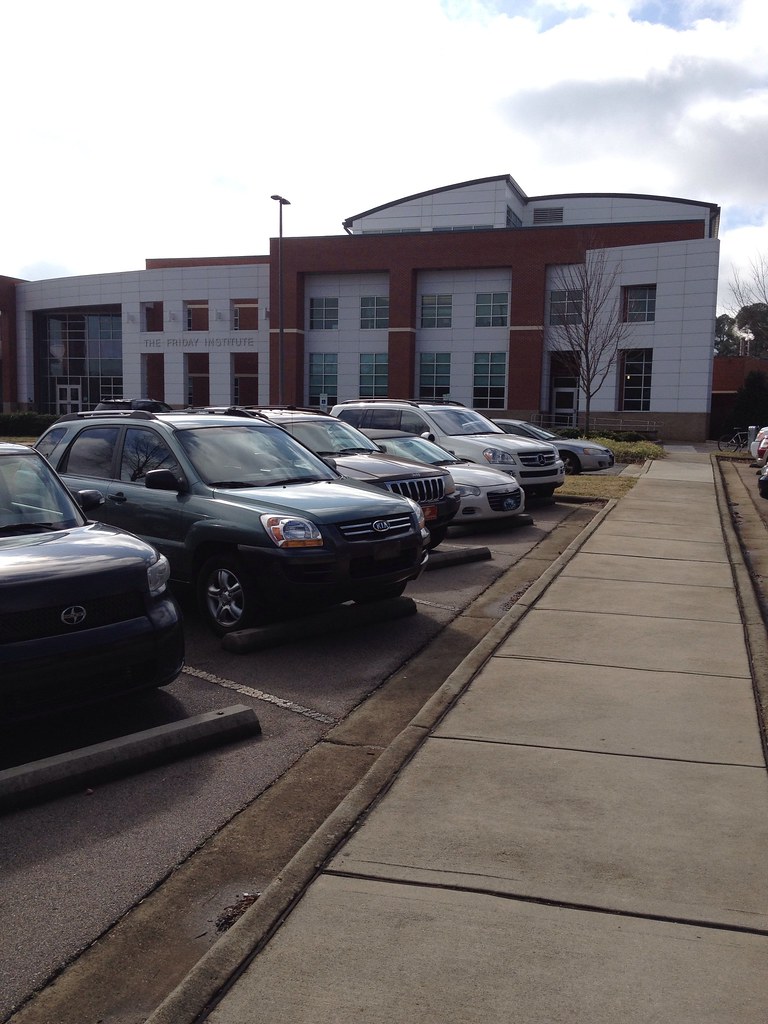
NC State’s parking action plan is projected to lose 1,700 to 2,000 parking spaces on North and Central Campus as early as this year as part of its physical master plan.
The NC Board of Trustees approved NC State’s physical master plan in June 2023. The physical master plan is designed to change NC State’s campus structure, affecting building renovations, pedestrian walkways and parking spaces.
At this time, the Department of Transportation has focused its efforts on student input for their parking action plan. Anne Austin, the Director of NC State’s Transportation Department, gave a presentation to the Student Senate with more details.
Parking reductions will be made by Lee Hall, Sullivan Hall, Bragaw Hall and Fountain Dining Hall due to the Cates West Development plan. This plan will demolish the buildings in the area and develop new residence halls and a new dining hall, effectively removing about 500 parking spaces until development is complete.
However, the largest reduction will be at the Coliseum Parking Deck, where 1,100 parking spaces will be demolished. In relation to this demolition, Senator Connor Rohlf said: “I know that’s a very crucial parking deck for not only students on campus, but also for visitors … So my question is, what are the plans for that space?”
To which Austin responded: “A lot of students park there, because essentially, we have it for events … So that I’d love to know kind of what folks’ ideas are for the Coliseum deck in particular.”
Additionally, Senator Preston Spencer asked: “Are there conversations or ideas of maybe there’s a new deck in a new location that’s even more beneficial than replacing the Coliseum deck?”
“Yeah, and it actually goes to the other senator’s question; it’s a location of question.” Austin said. “[W]e have so many commuter students parking in the Coliseum deck, but we could build a deck on that map I showed. We could build a deck, for example, on the Varsity line, or next to the current west deck; we could build another deck.”
Rebuilding the parking deck would cost around $35-40 million. “Our department received zero university or state funding for either parking or the Wolfline,” Austin said. “So, a $35 million parking deck will be borne by our customers — so the students, faculty, staff, visitors and events basically.”
Vanessa Solesbee, the principal planner at DIXON Resources Unlimited, presented three considerations based on what people will value most in regards to their parking experience. These considerations take into account parking costs, parking access, the ability to drive between campuses, the number of available permits and transit use.
The first consideration focuses on affordability by “optimiz[ing] existing parking assets and increas[ing] other modes [of transportation].” The cost of parking will remain the same while access to parking, ability to drive between campuses and the number of available permits will decrease.
“Prioritizing affordability would likely bring at least the most significant behavior change for what exists today,” she said.
The second consideration centers around availability, specifically adding more parking spaces in populated areas. By doing so, the number of permits for sale stays the same while “minimiz[ing] the impacts to permit fees and minimiz[ing] the impact of the parking access.” However, parking costs will increase.
The final consideration is convenience. Parking capacity is maximized, but parking costs will skyrocket.
After the presentation, student senators asked them about options with the Wolfline and GoRaleigh buses. Senator Adrianna Ras, concerned for fellow commuter students, asked if the Department of Transportation has communicated with the bus transportation system.
Austin stated that if there are fewer parking spaces or if they’re not inconvenient locations, plans are in place to increase the Wolfline service. “And we do need to figure out a way to do that without jacking up student transit fee,” he said. “We are also in communication with GoRaleigh, the city’s transit system, and [the] GoTriangle regional transit system.”
Protected bus lanes were also considered, but difficult to execute from an “engineering point of view.” Alternative modes of transportation aside from cycling and the Wolfline were described as infeasible or too expensive.
“We talked about [a] people mover system, a monorail, we talked about a gondola system. The conclusion so far has been that running buses is the most efficient and effective way to do that,” Austin said.
Another senator asked: “What plans [do] y’all have in terms of increasing accessibility for disabled students, because that’s already an issue in terms of transferring around campus?”
Austin responded: “We work on that every day. My colleague, Caitlin [Blakelock], is on the University’s Accessibility Committee. So both for parking and the Wolfline, and just for general mobility issues, as a campus, we have a long ways to go. But it’s something like a lot of issues comes down to funding, and we need more of it, and we’ve talked to university leadership about that.”
The feedback form for the parking action plan is currently closed. A final report will be made later this summer.