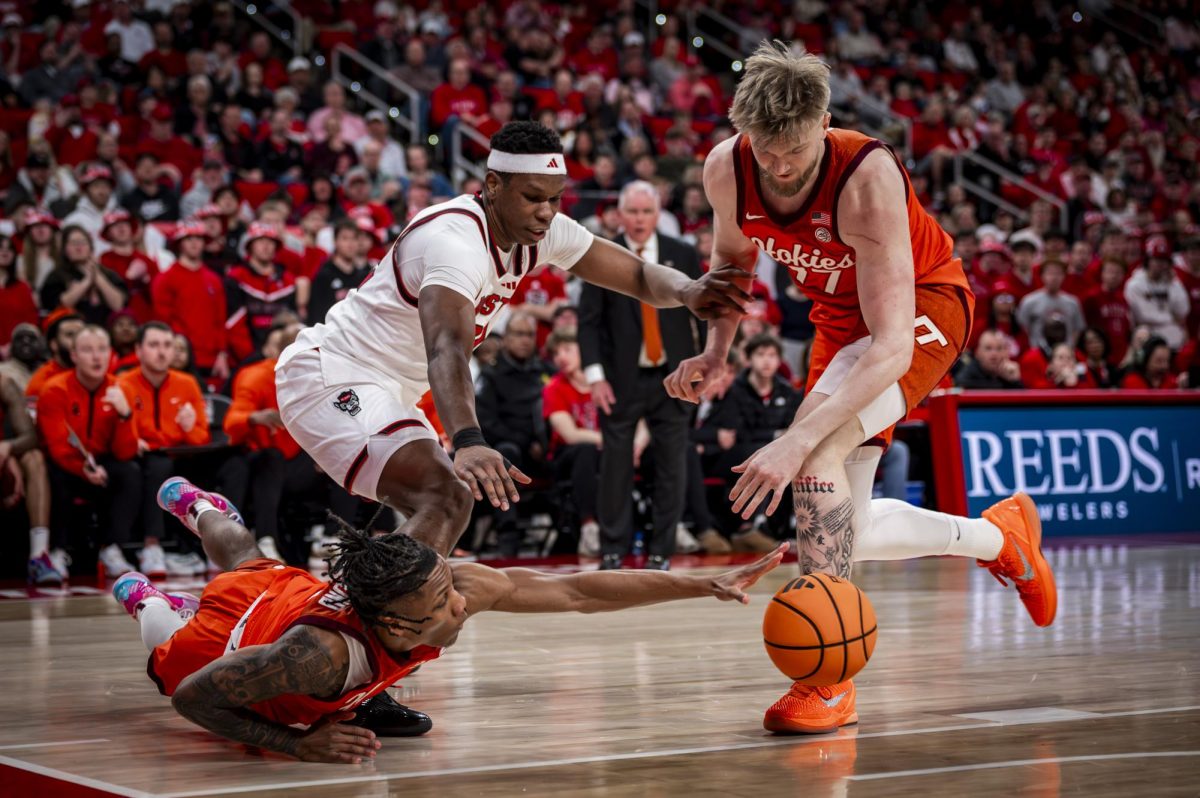
NC State went up against North Carolina Central University (NCCU) in Men’s Basketball at the Lenovo Center in Raleigh, NC on Nov. 3. The Wolfpack won the game 114 to 66, in front of 19,119 fans.
On the sideline, the Eagles’ coach Levelle Moton watched the Wolfpack push the lead. In the postgame press conference, he didn’t focus a lot on matchups or adjustments: he talked about the money.
“You’re seeing an NIL roster,” Moton said. “A twelve-million-dollar basketball team versus a zero-dollar basketball team.” There is no public number for NC State’s payroll, and while Moton likely exaggerated, the disparity is still real.
The scoreboard only tells a small part of the story. The rest lies in the widening gap between Power Five programs and HBCUs in the NIL (Name, Image, and Likeness) era. Now, more than ever, resources, facilities, alumni funding and the transfer portal shape rosters. Offseason decisions can look like open-market movement of free agents, and schools without financial backing often build teams later on and lose continuity.
Coaches and former athletes who have lived in both spaces describe a system where support for HBCU athletics isn’t just about resources, but about finding ways to strengthen these programs without erasing the identity and purpose that define them.
Sierra Solomon, a former women’s basketball player at NCCU, and now an Assistant Director and Academic Coordinator for Men’s Basketball at NC State, talked about some of the contrasts in day-to-day infrastructure. When she played, she recalled two full-time academic support staff members for the athletic department. At NC State, she said, there are closer to fifteen.
“And so that money really helps when you have donors who are donating like six figures, right? Seven figures,” she said. She mentioned that for some reason, HBCUs don’t have the same level of giving. And when those donations aren’t there, it limits what the athletic department can offer.
Because of these systemic reasons, as well as underfunding, HBCUs face unique financial challenges that impact their ability to provide some resources to athletes. Over time, the money missed out on can result in less infrastructure. Between 1987 and 2020, the 18 land-grant Black schools were underfunded by a total of $12.8 billion, adjusted for inflation.
In 2020, the North Carolina legislature appropriated North Carolina A&T $95 million, $8,200 less per student than the $16,400 per student it gave to NC State. NCCU was originally a teachers college, it did not open a graduate program until 1939. For all of these reasons, their endowment result lags behind the average.
Facilities make a difference as well. At NC State and UNC, the men’s and women’s basketball teams both have their own dedicated gyms to practice in. There’s a state-of-the-art weight room for revenue sports, it’s based from the resources that major programs like NC State have accumulated over decades.
This advantage becomes visible on the court. Coach Moton said after the loss, “Their wing is the same size as my postman,” he said. “We gotta go back and get in the weight room ten times a day just to have a chance.”
These disparities aren’t because of a lack of commitment from HBCU athletes or staff. They reflect the financial realities of two different ecosystems. In the NIL era those differences no longer stop at facilities; they extend directly to roster construction.
At high-prestigious schools, rosters now get finalized in early summer, focusing on players who already have postseason experience and the physical development that Power Five strength programs produce.
At NCCU, the process looks different. “When you don’t have money in the NIL era,” Moton said, “You don’t get to select a team until probably mid-July.” Most players entering the portal wait to see if a Power Five school will match their asking price. If no offer comes, they may sign to mid-major and HBCU programs later in the cycle. “It’s just so different,” Moton said.
He returned just two rotational players from last year’s roster. “Who am I to tell them not to go take the money?” he said. These players make a difference. NC State’s rotation includes players from Houston, Michigan State, Texas Tech and Arizona, programs that are no strangers to deep tournament runs.
“We have six guys on our roster that won an NCAA tournament game last year.” Will Wade said while discussing his emphasis on recruiting players in the transfer portal who have postseason experience.
And even NC State’s NIL figure may be dwarfed in comparison to other programs. Schools such as BYU, Arkansas, Duke, Texas Tech and others are schools “believed to be operating in the realm of this golden tier” of ten or more million dollars per year for their respective rosters per USA Today.
It’s just the reality of coaching in the system described. When the ball tips, the structural differences don’t disappear. And for programs like NCCU, competing in this environment doesn’t mean lowering the standard.
The decision to attend an HBCU comes from different perspectives for prospective athletes. “When I went there, for me, just like the family atmosphere and just the feeling of being around kind of people that look like me at the time,” Solomon said.
She said, personally, she preferred the smaller setting. “I enjoyed being able to walk across campus and see the same faces or, you know, not have to see like a new face every time, or not have to walk 20 minutes to a class. So that was my preference.”
As the conversation begins of how HBCUs can compete in today’s landscape, exposure, visibility, storytelling and national attention are recurring themes proposed to lift a program without turning into something that it’s not.
Solomon pointed to the impact of high-profile hires that have happened recently.
When Deion Sanders took over at Jackson State, she mentioned the immediate effect. “And so he [Deion Sanders] brought so much exposure and notoriety to that school where there was rappers, celebrities, like people coming into the games. And so with that was more media coverage, right? And so I think that that’s the temporary answer to me is, you know, if we could just figure out a way to have more coverage and more exposure for these schools.” She said that that kind of attention won’t fix everything, but it will shift some spotlight towards programs that rarely get it.
Moton echoed this idea of exposure from a different perspective. He discussed “buy games” and that they may be part of the solution. “Buy games” are games where Power Five schools pay smaller programs to come play them. “We get to drive twenty minutes and you guys pay us, and we get to net all of it,” he said of the NC State matchup. Those payouts do help to fund athletic departments and the exposure can do a lot for the school.
The challenges described aren’t new; the NIL era has just made them even more prevalent. The landscape is shifting quickly. No solutions will close the gap overnight. But the future of HBCU athletics is shaped by what they’re trying to build on their own terms.