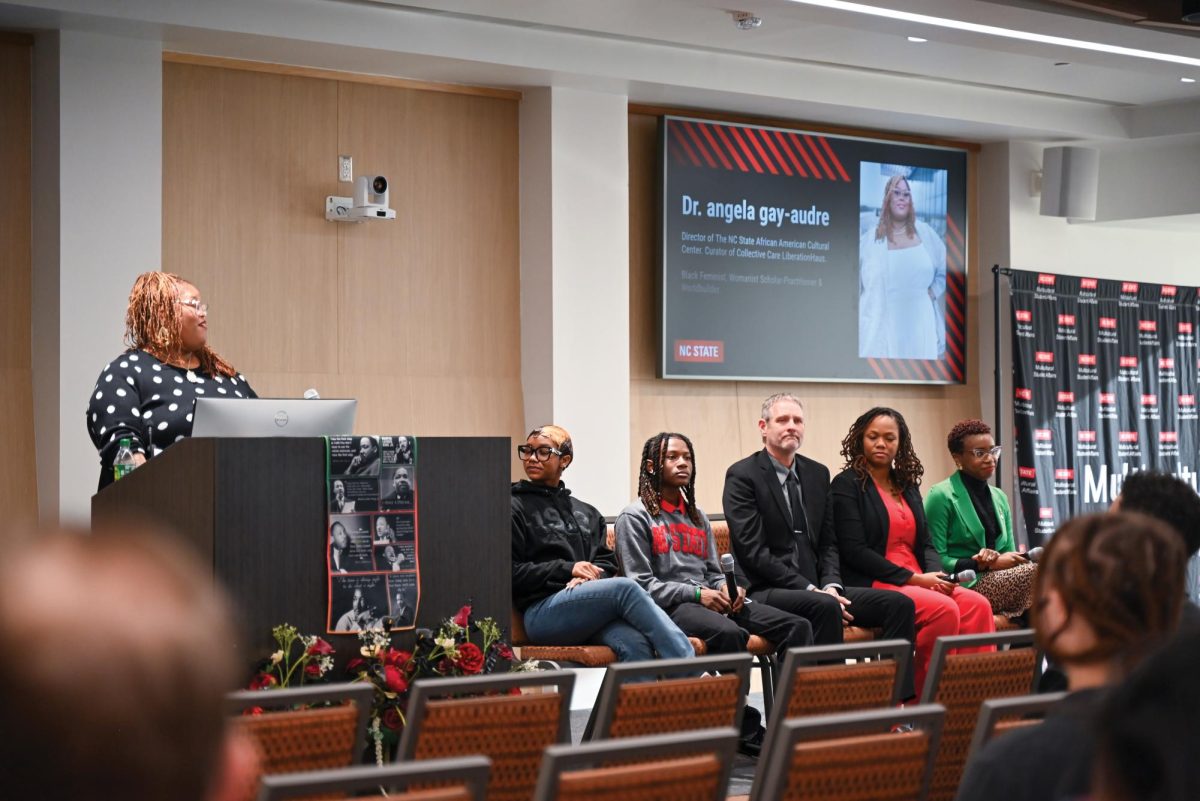
Multicultural Student Affairs (MSA) and the African American Cultural Center (AACC) hosted the MLK Campus Commemoration Keynote at Witherspoon Student Center’s Washington Sankofa Room on Jan. 20.
The keynote featured a panel discussion with panelists from diverse backgrounds and different generations. This was an opportunity for attendants to engage with and discuss this year’s Dr. Martin Luther King Jr. Campus Commemoration Week theme: “Lifting as You Climb: Honoring Legacy and Empowering the Future.”
Every year, to celebrate Martin Luther King Jr. Day, Multicultural Student Affairs organizes a campus-wide commemoration week to remember the life of Dr. Martin Luther King Jr. The week-long celebration is filled with a myriad of events meant to engage students and staff, faculty and members of the community.
Five panelists attended: Coen J. Jones, a third-year majoring in nutrition science and the vice president of NC State’s NAACP chapter, Caiden Smallwood, a second-year majoring in psychology and an ambassador of the AACC, Dr. Courtney Hinton, the Campus Health medical director and a board-certified family physician, Dr. Jason Miller, a distinguished professor and public scholar and Dr. Jemilia Davis, the Human and Organizational Leadership Development and Clinical Assistant Professor at UNC School of Education.
The panel was intergenerational, designed to bridge the gaps between those who have cleared the way and those who have yet to find their own path.
The keynote began with Dr. angela gay-audre, director of the AACC, giving a brief welcome to attendees before introducing Korie Roane, an intern at the AACC. Roane serenaded the crowd with a beautiful rendition of Sam Cooke’s “A Change Is Gonna Come.”
After the performance, Leslie Cochrane, the administrative support specialist of MSA, came to the stage offering insight before the panel discussion. Cochrane centered the energy of the room by pulling focus to the life and legacy of Dr. King. She spoke of how we often hear his speeches, but putting the values of those speeches into day-to-day practices is something entirely different.
She described “lifting as you climb” as a mandate more than anything else, that success is hollow if one goes through it alone. She ended her speech by inviting the audience to keep two things in mind during the discussion: “Who am I lifting?” and “Who is helping me climb?”
The first topic discussed was personal imagery or memories and their role in how the panelists shape their worldview and leadership style.
Many of the panelists emphasized their families, especially Dr. Hinton, who described the impact her grandparents had on her life since they played a large role in their communities through mentorship and giving back. “I think it shaped a lot of how I show up in my role here at NC State and in my role as a fellow mom-scholar and in all the ways that I show up for the people that I care about.”
The panelists described “lifting as you climb” as a journey, with constant trial as one pulls from the bottom as they reach for the top. This prompted gay-audre to bring up an important topic in Black feminist scholarship: how power comes from below. The panelists discussed where their own power originates from and how it often comes from a collective or their roots rather than from outward sources.
Dr. Davis said that it’s imperative to never lose touch with who you are or become unrecognizable to those who came before you. “The ground swell that got me to where I am today, I need to be as embedded to those groups as I am to maybe the access that I’ve gained to different environments,” she said.
Another topic discussed was Sankofa, which is an African word that translates to “it is not taboo to fetch what is at risk of being left behind.” Panelists discussed how they carry that with them in their lives.
Jones emphasized the importance of looking to the future and not romanticizing the past. “My past is not what defines me, but it helps me in ways that I’m not thinking about actively…I’m always thinking about the person in the future, because who does she want to look like? What does she want to say?”
The final topic discussed by the panel was envisioning the future and their own role in it, as Dr. King once did. The discussion focused on joy and having room to be one’s authentic self without being stifled in the future. There is room for growth while also aiding those around you. Smallwood hopes to bring positive change and spoke on how “it’s a misconception that innovation and empathy can’t coexist.”
With that, the panel was then opened to questions from the audience. Many questions came up and furthered the discussion on the themes of involvement and community. The panel closed with final thanks to those who participated and another serenade from Roane, this time with “Stand by Me” by Ben E. King. A reception was held afterwards for the attendants and panelists.
During the reception, we had the opportunity to interview two panelists, Coen J. Jones and Caiden Smallwood, to better understand their motivations behind joining the discussion, and if there was anything they would like to elaborate on.
Caiden joined the panel since he has public speaking experience, but he also has a deep interest in history. He mentioned the importance of events such as the keynote and their positive impact on campus culture. “I think it’s good for campus, community is good for just acknowledging history, acknowledging what happened before, and I think it’s great that it’s open to everyone.”
Jones said that the themes of the event had deeply resonated with her, especially since lifting others with her is “a big thing that I want to do in my career and daily life.” When asked about balancing feeling deep empathy for others in a highly competitive academic environment, Jones emphasized that her path is entirely her own. “I will do what feels right to me because if it doesn’t feel right to me, then it’s probably not for me … understanding that throughout my entire course of college has been super important.”
The keynote panel not only connected people, but it reminded us of the importance of legacy, especially in a world where that history is constantly being forgotten. To connect with our roots is to connect with our deepest, most authentic selves, even as we move forward.