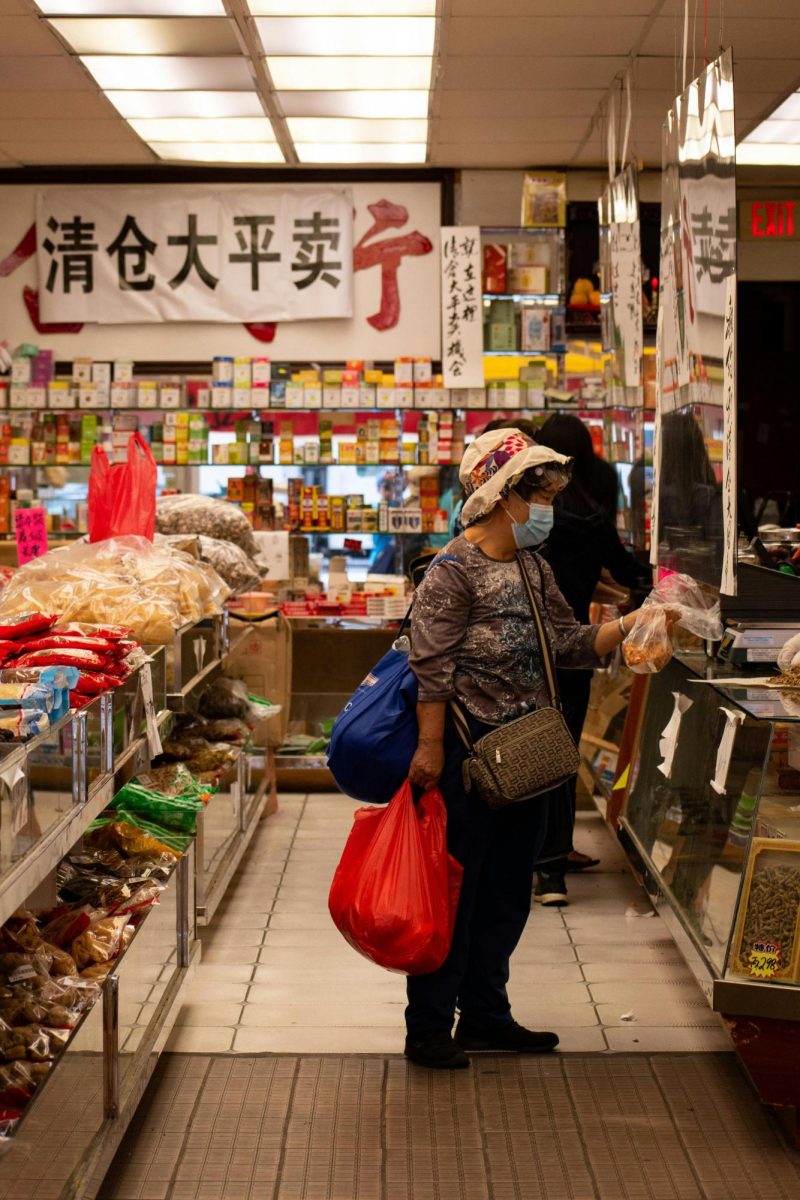
I remember when Asian grocery stores had low ceilings, damaged linoleum, grime in the corners, handwritten characters on index cards taped to produce boxes and water damage in ceiling tiles. They were small, local family-run shops. They helped their relocated communities access the ingredients from their homelands. There were old ladies with visors and brooms to sweep the streets. There was a community.
I see my journey with Cantonese food as a way to remain connected, especially since I don’t speak Cantonese or Mandarin. I’m Wasian — a third-generation Chinese immigrant. I feel separated from the culture my grandparents brought over, so I try my best to stay connected to it.
Today, access to these stores has improved. But, that accessibility to Asian food and imported groceries becomes an issue when people cannot acknowledge the politics of the food they interact with and how they treat the people it originates from.
In rural United States, there’s a lack of Asian grocery stores. When I lived in rural Wisconsin and rural New Jersey, we had to travel upwards of 45 minutes to go to Asian grocery stores. Large chains like H-Mart help with access to these groceries for many, especially East Asians given that H-Mart is a Korean-oriented store.
H-Mart has over 97 locations, but increased access for Asian communities also includes non-Asian communities. Access for everyone isn’t bad, but it’s an issue when Asian groceries are seen as a novelty over a necessity for communities.
People outside of the Asian diaspora have shown interest in Asian food; however, they pick and choose what aspects of Asian cultures they want to consume. Commodification separates food from its origins. For example, bahn mi is a result of French colonialism in Vietnam, using pate and baguettes brought over by the French. To ignore this history is to ignore Vietnam’s historic struggle and how their food embodies that.
There are signs of potential appropriation of an ingredient: like whether or not it has a signature and marketable color, an inoffensive flavor, but being just foreign enough where it can captivate an outside audience. This happened with ube, both of them having vivid colors and a relatively inoffensive taste. Ube was put into desserts, drinks and products that used ube’s color to market themselves without acknowledging the Filipino origin.
It’s common enough in the Asian community that it became a joke to predict which foods will be co-opted next. A TikTok creator by the name of bertubble has made videos about stores, such as Trader Joe’s, gentrifying and co-opting food.
There are other political implications beyond historical colonialism, like also how Asian food has been treated. Asian food is seen as cheap, dangerous and containing “mystery” ingredients — treating Chinese immigrants and Chinese Americans as dirty. During the Coronavirus pandemic, President Trump labeled it the “Kung Flu” and showed how many Americans feel about Asians.
The Asian American community has been harmed by other groups in America through appropriation, so seeing foods and other cultural characteristics co-opted hurts. And frequently, the communities they originate from respond with education and think-pieces soon after. For example, soy sauce marinated eggs were named after a white TikTok creator as “Courtney Cook eggs,” despite originating in the Korean community. The Korean community responded to the appropriation with reasons why people should respect the cultural origins of their food.
Separating the food from the people erases a crucial part of a culture. A lot of people tie their Asian American identity to the foods they consume — especially as they drift apart from their parents’ or grandparents’ culture. And it’s even more harmful when recounting bullying from school years or menus having to adapt to American tastes.
And I don’t think that struggle for connection is something that can be easily glossed over or commodified. The lack of accessible Asian groceries has definitely impacted how much I’ve been able to connect through food, and seeing people disrespect East Asian foods hurts.
The accessibility to Asian food is important, but that does not nullify the harmful effects of consuming culture, discarding it and then not knowing the history or politics of consuming it. People and their cultures are connected to these foods, and to treat the food as only a commodity is dehumanizing.