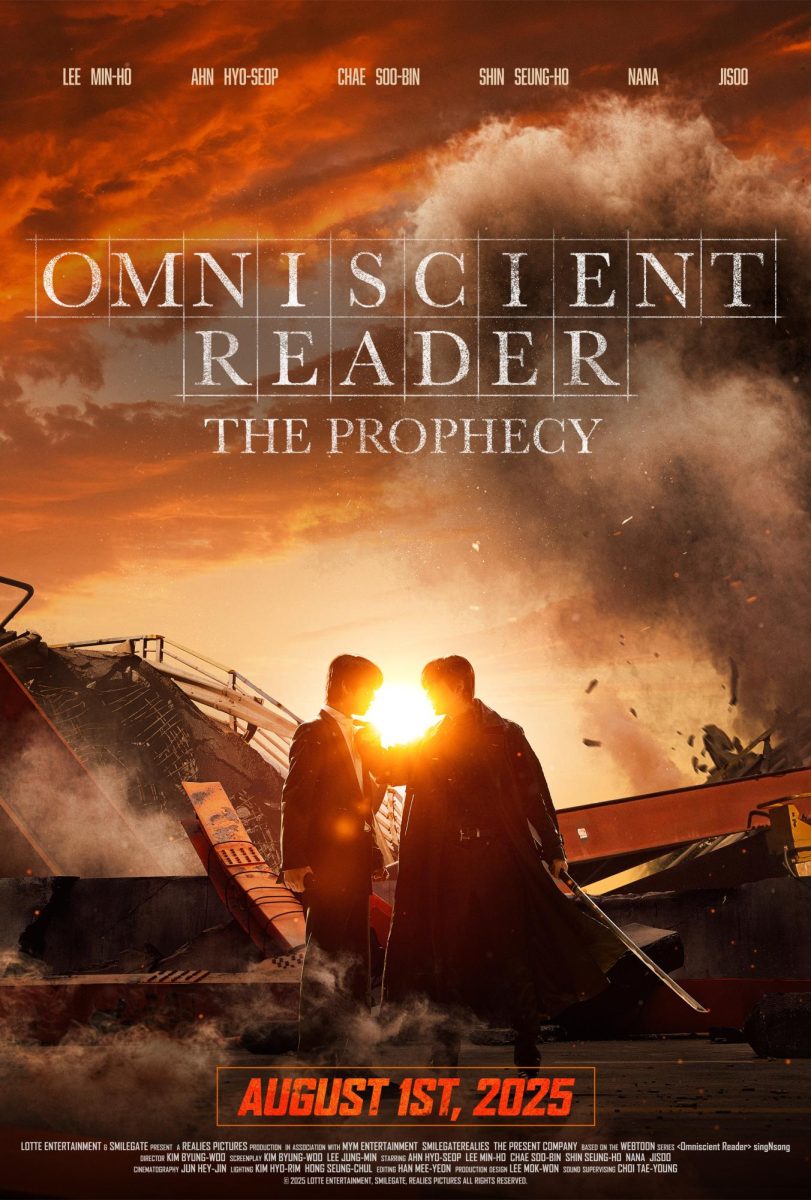
Book-to-movie adaptations have consistently been a huge hit with the general public. Whether the audience has read the original source material or not, they’re bound to find something to rave over. However, not all movie adaptations are made equally. It’s an unfortunate trend that’s reached the live action adaptation of “Omniscient Reader’s Viewpoint” called “The Prophecy.”
“Omniscient Reader’s Viewpoint” was originally a webnovel that followed an ordinary office worker named Kim Dokja, who reads a story set in an apocalyptic world. Right before the ending of the story is released, he finds that the apocalyptic story has come to life. With his knowledge of future events and the characters brought to life around him, he and his companions embark on a journey to reach the end of the story.
The apocalypse is triggered by a video game-like system that generates life or death events for the entertainment of higher beings called Constellations. Constellations are made up of fictional people, as well as historic and religious figures. Enacting these events are creatures called Dokkaebi, goblins from Korean folklore.
Cinematography, Design and Directional Choices
Right out of the gate, the cinematography is trash. It relies heavily on the video game aesthetic with stale side-scrolling camera angles and tacky monster designs.
They frame combat scenes in a Street Fighter style, effectively highlighting how bad the fight choreography is. In a scene where Jung Heewon is fighting a gang, you can see one of the members breaking off from the main group to be out of frame. The person doesn’t fight Jung Heewon until she approaches them, giving the impression that they were waiting for the camera rather than progressing the story.
It also doesn’t help how artificial the CGI is. For one, the design of the Dokkaebis were originally furry,
with a balance of an unnerving appearance to humans and a charming personality for Constellations. Their existence hinges on entertaining Constellations by exerting some level of control over humans.
But in “The Prophecy,” they were changed into ugly, plastic robot Labubus. By making them cute and marketable, the movie ends up losing its horror factor and instead looks like a game advertisement.
This brings me to the director’s choice to switch out the weapons. Although they didn’t fully commit the changes, they show characters who are meant to be sword masters relying on guns. The biggest victim to this is Lee Jihye, who is the student of Yoo Junghyuk.
Director Kim Byung-woo explained his decision to change her weapon in the following interview with Chosun Biz: “I made this decision (of Lee Ji Hye using a gun) after long [thinking] about what can explode the character at the most dramatic moment … I believe it will be fully understandable when they see the film rather than through long explanations.”
However, the fans’ worries came true when Lee Jihye debuted as a sniper in the movie. She retained her agility-based skills, but her choice of weapon rendered them useless, forcing her to stay hidden.
Additionally, in changing her weapon to a sniper rifle, she loses the close mentor-mentee relationship she had with Yoo Junghyuk, similar to how Jung Heewon’s weapon was changed from a sword to a set of daggers. It results in both Heewon and Jihye losing their relationships as female frontline fighters adept with the sword.
Evidently, the narrative blatantly sidelines women.
Character Assassinations
Some character assassination is inevitable in adaptations. Scenes for character and relationship development are sacrificed for screen time, making characters a shadow of who they truly are.
Surprisingly (or maybe expectedly at this point), the main character Kim Dokja has one of the worst cases of character assassination. He’s shown to hate the apocalyptic story when in the webtoon he shows a deep love for it because it was his salvation at one of his lowest moments.
As a source of salvation, Kim Dokja knows and understands each character of the story inside and out, to the point where it becomes one of his skills during the apocalypse.
In the movie, Kim Dokja is shown to have a shallow understanding of the characters, shown by how surprised he is when Kim Namwoon viciously beats an elderly woman for survival. This is in direct contrast to Kim Dokja explicitly stating he expected Kim Namwoon to be cruel.
Kim Dokja has a complicated past and in the webtoon it’s shown that his most traumatic memory was when his mother killed her abusive husband. Later on, it’s revealed that Kim Dokja was the actual murderer and his mother took the blame.
However, “The Prophecy” changed it so that Kim Dokja killed a classmate in a severe case of bullying where both of them were victims. This change is significant to his character. In the webtoon, Kim Dokja disdains the Constellations because of their similarity to news reporters who hounded him after his mother published a book on killing her husband.
His hatred of them is more personal compared to the changes the movie made. It turns his conflict with the Constellations into a battle of ideals and eliminates the importance of his relationship with those in his team as they become a family.
Additionally, he is confident that the world will cease to exist when Yoo Junghyuk dies when in the webnovel, this is never confirmed nor tested. Because of this uncertainty, Kim Dokja in the webtoon is actively preventing Yoo Junghyuk from dying. This made the scene of Yoo Junghyuk dying absolutely absurd.
At the same time, side characters such as Yoo Sangah and Lee Hyunsung are reduced to nothing but a shell of who they are.
Where Kim Dokja is an isolated loner with mediocre skills and education, Yoo Sangah is a popular, full-time employee at the same company and disciplined both mentally and physically. She acts as a foil for Kim Dokja.
Not even five minutes into the movie, Yoo Sangah is changed into a less capable person compared to her webtoon counterpart. She’s in a constant state of confusion and fear instead of being cool-headed and adaptable. She is Yoo Sangah in name only.
Lee Hyunsung suffers a similar fate. In the webtoon, Lee Hyunsung showcases his resourcefulness and care for others. He’s the shield of the group, protecting them from threats rather than being a frontline combatant.
In the movie however, he is more useful carrying children than a source of protection. He gets three moments to shine and none of them were relevant to the plot due to the excessive scene cuts and rewrites. Scenes where Lee Hyunsung is supposed to be shown as a dependable character are sacrificed for Kim Dokja to shine.
Final Thoughts and Considerations
What should’ve been a celebration and love letter to the original webnovel and its fans has been turned into a circus show that steals the money of fans while spitting at their faces. Although, I think that the biggest victims of the adaptation are the original authors, singNsong.
Writing Omniscient Reader’s Viewpoint had taken them two years and one month of consistent updates and lengthy chapters. This story had been their first big hit, followed by their other novel The World After the Fall.
The best act of kindness at this point would be to completely scrap the next four films and make “The Prophecy” the sole stain in their careers as writers.