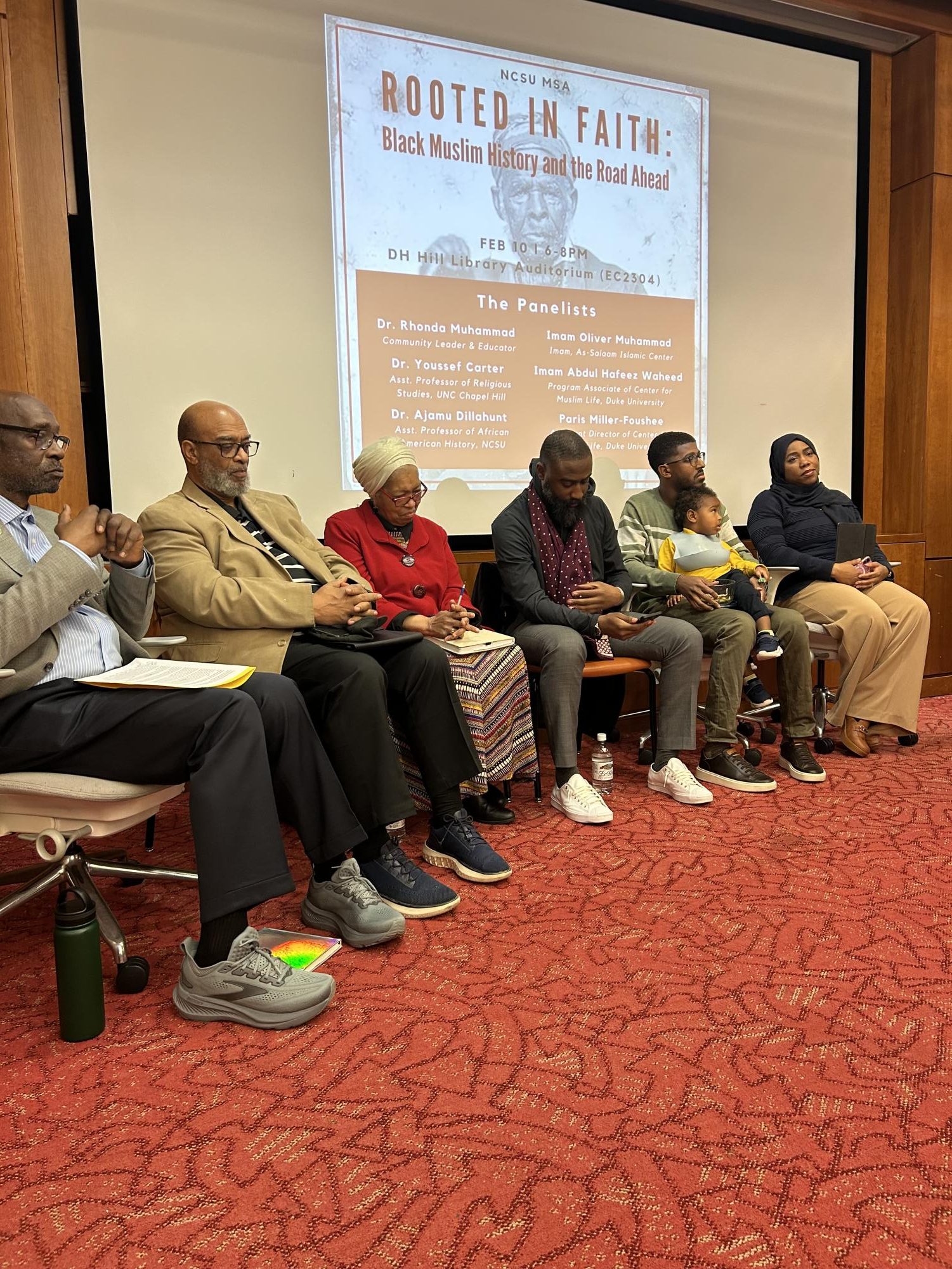
The connection between Black Americans and Black Muslims from the Nation of Islam is deeper than we realize. The Muslim Student Association (MSA) hosted an event “Rooted In Faith: Black Muslim History and the Road Ahead,” on Feb 9. 2026, in DH Hill Library. The panel of six discussed Black Americans’ contributions to the Nation of Islam in the United States.
The event offered a lot of cookies and brownies for attendees, but it was really about providing wisdom and guidance to the next generation on the Black Muslim and Black American connection.
Dr. Paris Miller Fushi is the assistant director of the Center for Muslim Life at Duke University.
When asked about the contribution of Muslims she said it was building institutions and how Black women have been at the center. She talked about Clara Poole and how she challenged the education system by homeschooling her children.
Dr. Youssef Carter is an assistant professor of Religious Studies and a Kenan Rifai Fellow in Islamic Studies whose work centers on Black Muslim history, Sufism and Islam. He explains that Black people contribute to the Nation of Islam by holding a humanistic impulse that no one is above the creator. “Islam is inherently Black,” Carter added, not with the association of skin color but with identifying with the oppressor.
“I think about how many of our slave brothers and sisters who came here in the holds of ships, how many of them were actually Muslim, and they had to hide their practice,” said Dr. Rhonda Muhammad, an educational leader and chairperson at As-Sallam Islamic Center. She went on to say, “when people practice the faith, it’s not the norm in this country… And just because we haven’t experienced it doesn’t mean that it’s less than.”
The conversation transitioned to how and why the Nation of Islam resonates with African Americans. Imaam Oliver Muhammad serves as the resident Imam of As-salam, Islamic Center of Raleigh.
He discussed the idea of redemption when he said that when Islam came to America it met people right where and “it found the people who had lost their identity.”
He mentioned how “everything white was beautiful…. but when it comes to Blackness, it was inferior, it was evil.”
Rhonda Muhammad opened up with her own experience growing up with Muslim parents.
“I can remember my parents became Muslims in 1954. And I was three years old. And I can remember… Growing up… that not only was there segregation, but there was degradation. There was total dehumanization.” She continued, “And so, when you think about the attraction of the Nation of Islam to Black people, it provided… a means, a message, and a vehicle to begin to feel a sense of pride.”
Carter also spoke about the Nation of Islam’s affordances within the Black community.
“It’s also one of the few organizations that is successfully able to protect Black women in a time when Black women were very, very vulnerable,” said Carter.
Dr. Ajamu Dillahunt Holloway is an assistant professor of African-American public history at NC State University. He briefly mentioned Carter G. Woodson and how the Nation of Islam was actively recruiting Black people to join and there was a mutual level of respect, even if a Black person didn’t join. He said, “I wanted to reach my people and popularize our history; you had to engage. You had to go through the Nation of Islam.”
The final question of the night was about resilience and the unity of Islam in America.
Rhonda Muhammad mentioned that one of her Caucasian friends converted to Islam and that it’s not the same as an African American accepting the faith and that it made her think outside of her Blackness.
“It will be a great day when we don’t have to use kindergarten colors. Black and white,” said Rhonda Muhammad.
Imam Abdul Hafeez Waheed, Duke University’s 1st Muslim chaplain in 1998, said that the overall goal of Islam is to “help human beings reach their full potential.”
He explained that redemption has occurred in the African American community and brought up examples such as Malcolm X and Muhammad Ali, and how they were affected by the process of converting to Islam.
He closed the discussion by saying, “the Nation of Islam taught us to be independent thinkers” and “we’re not trying to adopt anybody else’s culture. We’re going to be what God made us.”