Walking into a stank classroom with yellow walls, small arm desks and squeezing into a seat stuck in an auditorium filled with men is the easy part. I’m rushing to reach the second row of seats, otherwise I’m staring at a head of unwashed hair or broad backs for the next hour. I’m sinking into the scaly seats for my own space because I’m an invader in theirs.
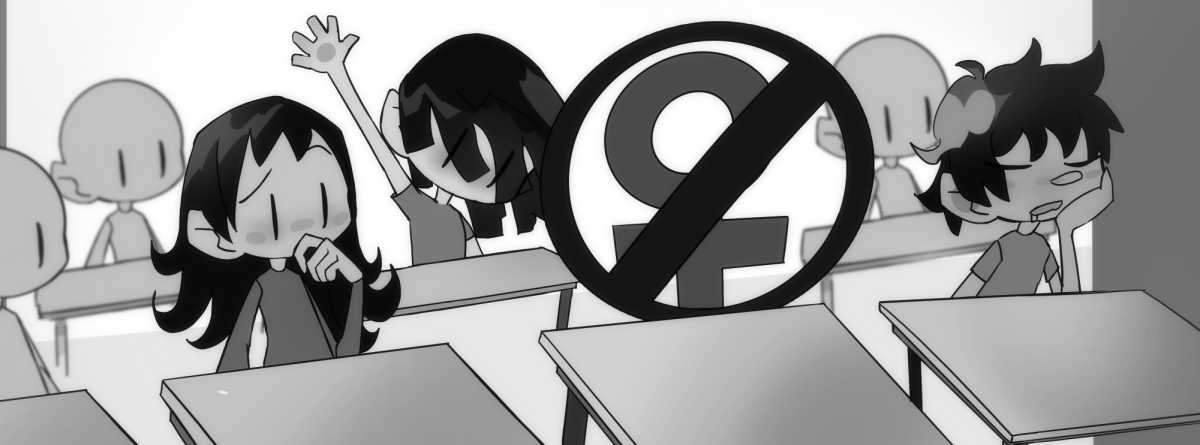
Being a woman in engineering can be an isolating experience, even from a cursory look around a classroom. Space is something we’re all conscious of. And over time, you become more attuned to who’s taking up the space and less of who isn’t.
NC State’s For The Pack visual analytics for fall 2025 says thats, roughly 19,311 women have enrolled in NC State. Honing in on the STEM and Health field, about 44.69% of STEM and Health majors are women. A 10.62% difference may not seem much, but that 10.62% represents the 2,458 men who outnumber the women.
These aren’t just numbers; they’re what women in these male-dominated fields see every waking day. When asked what they didn’t expect expect to experience in their, third-year studying biomedical engineering major Audrey Johnson said, “[biomedical engineering] is the closest to a 50/50 gender split. So we actually see a lot of women. It’s great.”
This gender demographic isn’t restricted to students either. Third-year studying biomedical engineering Tori Baxter adds, “Same thing with professors too.”
Out of the 21 engineering majors offered at NC State, not including concentrations, only biomedical engineering is the closest to an even men-to-women ratio. And that brings up the question: why aren’t there more women in engineering?
The Institute for Women’s Policy Research (IWPR) indicates that stereotypes are one of the major contributors to the issue. STEM topics are associated with “masculine qualities,” which are opposite of “feminine qualities.” Early exposure to these stereotypes makes young girls and women internalize these and deem themselves unqualified for gendered occupations.
It’s easy to feel like an outsider when you’re constantly told that engineering is a male-dominated space because everyone just has to point out the obvious. We cannot exist without the constant reminder that we don’t belong.
I feel it in my general education classes where I have to rush for the front row seats or else I’m stuck staring at concepts of a projector. I feel it on my way out of a classroom, having to give way to hulking bodies so I won’t get pushed around. I feel it when I walk into the worst bathroom known to humanity, where an antique space heater is taking up space for a third stall.
Finding support in male-dominated fields, especially one as rigorous as engineering, is more important than ever. Programs such as Society of Women in Engineering (SWE), InspirENGR and Women and Minority Engineering Program (WMEP) rise up to the occasion.
SWE is one of the older programs and was founded in 1950. They focus on helping women through networking with local colleges and holding events with company sponsors.
InspirENGR supports younger girls in engineering through workshops and mentorship programs. Baxter is a member of InspirENGR and shared her experience in the mentorship program and said, “We reached out to high school students, and we walked them through labs, and then we got to do a tour of textiles.”
WMEP was formed in 2012 and is a combination of two NC State programs: Women in Engineering (WIE) and Minority Engineering Programs. The change was made when the director of WIE, Laura Bottomley, set her goal to “change engineering to fit the students.” Johnson also works as a mentor for WMEP, describing her experience as “a lot of fun. I enjoy being there and helping with planning schedules and answering any questions they have.”
In each classroom, we have to prove we belong, and that the 2,458 women who could’ve been in engineering deserved to be here, too. We must take steps to not only encourage young girls and women to pursue it as a career, but to establish that we’ve fought for our seat in the lecture halls — and it isn’t going anywhere.