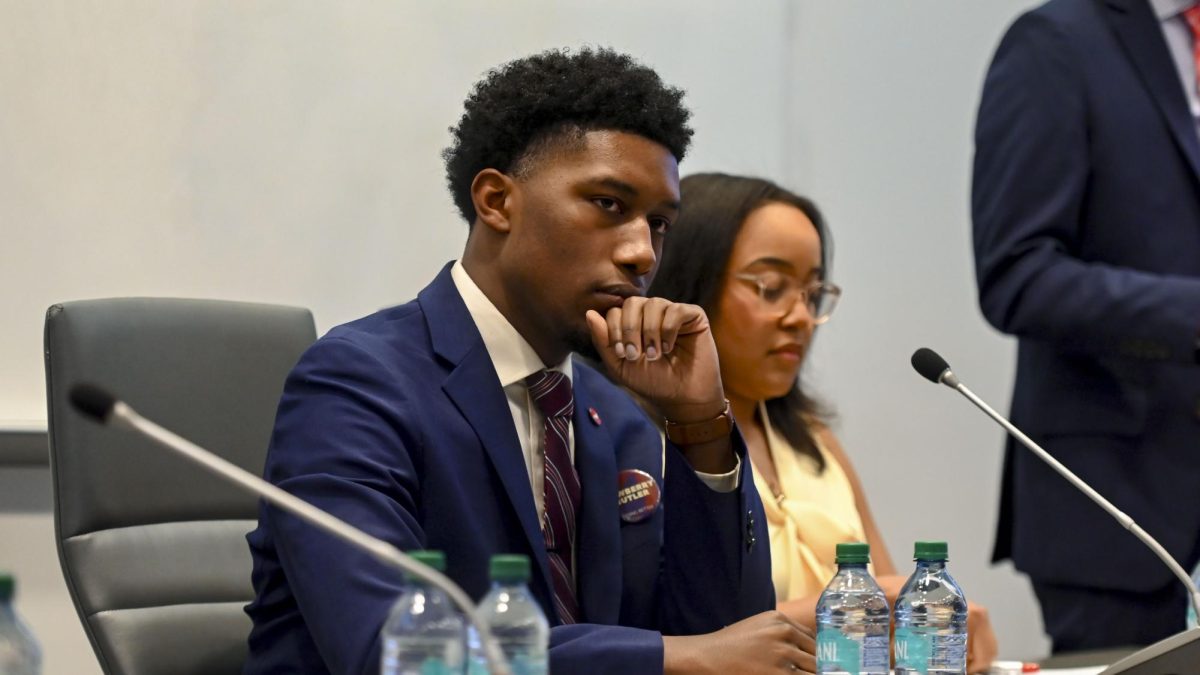
NC State’s Student Government held its sine die meeting, the last Senate meeting for the 105th session. It kicked off at 7:45 p.m. with 30 members present, meeting the minimum requirement for quorum.
Former Senators Beck Whitehead and Executive Chief of Staff Chloe Webster made the issues clear during the 15-minute period of comments and announcements.
Comments and Announcements
Beck Whitehead, the president of the college democrats of NC, addressed the Senate during this time. His speech focused on the Student Body President election and how it reflected on the Student Senate.
“We just told one of the largest voting blocks in our history that their voice is worth nothing. This isn’t an election. This is masquerading as democracy. And now we look at the result. Because of this carnage, we are left with a winning ticket that represents the narrowest, most inexperienced corner of this campus.”
Additionally, Whitehead expressed concerns of the Student Body President and Vice President for the 106th session. “I’m not confident that this new administration even knows where the heartbeat of the student body actually lies. Hence, it’s outside a fraternity circle,” he said in reference to Trask and Stack’s focus on Greek life.
Whitehead urged the Student Government to change and advocate for the student voice.
“If we don’t move toward reform, whether that’s right choice voting, actual transparency, actual representation and then actually respecting the balance cast, then this isn’t Student Government. It’s just a play ground for the few while the thousands wait outside the gates. This reminds me of a different current government. Fix the system or continue, like the previous senator mentioned in their committee report, to be large and invisible.”
Afterward, Executive Chief of Staff Chloe Webster, a part of the Student Body President ticket that withdrew early in the race, spoke about the need for community as the 105th session came to an end and the 106th session was ready to begin.
“As we go into the next session, I encourage all of us to set aside our preconceived ideas about those we work with, and extend to each other the opportunity to flourish in our pursuits, to better our campus community, not by getting in each other’s way, not by spreading doubt and hateful comments as we so often have seen loom over this organization, but to give love to yourself and your neighbor, as this is how we lead together and best represent our students.”
After a 10-minute wellness break, Senators returned to the chamber and began discussing two key pieces of legislation.
R154 – Changing Unexcused
Absence Policies Act
Corresponding Senator Diya Dhananjay introduced R154 with the goal to establish a standardized absence policy framework to reduce confusion and maintain fairness for both students and professors. An issue Senator Dhananjay discussed with students was the impact of absences on grades.
Although the Student Government would be providing professors a policy framework, the legislation maintained the academic autonomy of instructors. Senator Dhananjay had conversations with Senior Vice Provost for Academic Strategy and Innovation Helen Chen and Executive Assistant to the Senior Vice Provost LaTissa Davis during development.
In the following clause, Senator Dhananjay emphasized academic autonomy, saying, “these discussions emphasized that course syllabi are inherently malleable documents that may be adapted when necessary to improve clarity, efficiency and student learning outcomes.”
Senator Adrianna Ras gave a pro-debate with her personal experience on attendance specifically using TopHat impacting her grade. “[The professor] would have warm-up TopHat questions that counted toward your grade if they were right before class. So if you got there at 8:30 a.m., it was an 8:30 a.m. class and you missed the TopHat question, you would get a zero for that question.”
With a motion from Senator Kaleb Garcia to move to voting, the legislation passed 32-0-0.
R155 – Wellness and Reading Days in Academic Calendar and
Syllabus Act
Corresponding Senator Diya Dhananjay introduced R155 which added two wellness days, one in the Fall semester and another in Spring, and a reading day during finals week for both semesters. The corresponding Senator used UNC Chapel Hill’s academic calendar as reference when making these additions.
In the side-by-side semester comparisons, the key observations made were that NC State had less days for recovery and mental health despite the near identical academic calendars. During her overview of the legislation, Senator Dhananjay stated that the additions are possible under the Southern Association of Colleges and Schools Commission on Colleges (SACSCOC) accreditation standards.
“Additionally, SACSCOC accreditation, which is what we use in the southeastern region, standards do not restrict these adjustments, but instead encourage institutions to design policies that support student success and learning outcomes.”
R155 passed in the Senate 32-0-0 and the Senate adjourned.