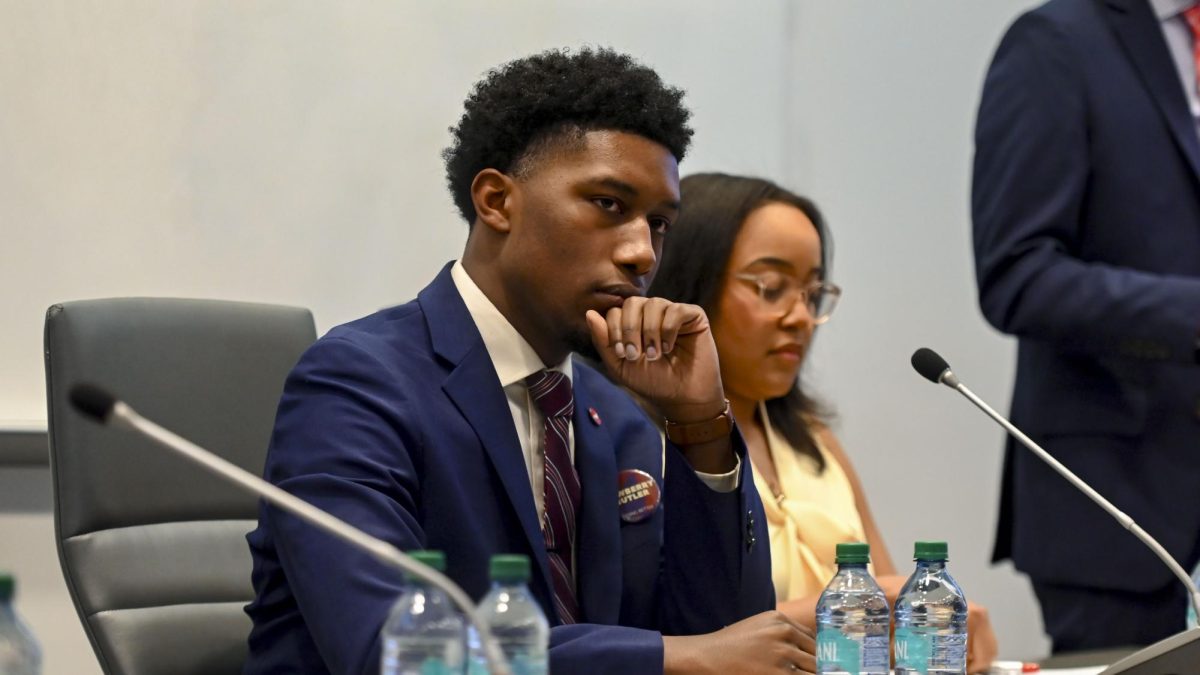
During the Student Senate’s meeting on Feb. 26, Student Body President Isaac Carreno delivered a veto message concerning a government bill short-titled The Justice Through Service Act. Carreno had outlined four main issues with the government bill: legal requirements, conflict with existing student conduct structure, redundancy and unclear authority.
The Justice Through Service Act was initially introduced in response to recent events described as, “the breakdown of ethical discourse” and “public conflict escalation.” The aim of the bill is to restructure the Justice Department and in turn, enact reforms to the ethics board.
The Justice Through Service Act underwent a second reading at the last Senate meeting on Feb. 11 and corresponding Senator Ava Butler described the role. “…no legal advice is actually involved.
It’s purely focused on university statutes, whether that be the student handbook, the student government statutes and constitutions or the student code of conduct.”
However, Carreno had submitted the bill to Student Legal Services’ Interim Director, Michael Avery, who said he, “could not envision how the responsibilities assigned to the Attorney General could be carried out lawfully without licensed legal training.”
During the questioning period, Senator Preston Spencer asked about the potential liabilities Student Legal Services had discussed. According to Carreno, Avery had said he, “would not be able to provide [advice] as that would be inflicting upon the university contract and not getting involved in student matters.”
The lack of training would also risk the Attorney General missing reports that requires a mandated reporter. “If something more serious were to escalate out of that report, then not only the Attorney General but the Student Government could face significant liability,” said Spencer in light of Student Legal Services’ inability to provide support.
Additionally, Senator Katie Stennette asked Carreno to clarify which responsibilities in the statute would require an attorney. In the detailed veto document, Carreno outlined section 4-5.1 that says, “the Attorney General may ‘represent or accompany students in administrative meetings.’”
“When you go before Student Conduct in [academic misconduct] cases, you cannot have representation,” Carreno said.
The Justice Through Service Act section 4-4.8 discusses the Chief Justice position and asserts that the position will hold voting power amongst the Student Conduct Board “as the representative of Student Government.” In Carreno’s meeting with the Director of Student Conduct, Thomas Hardiman, this specific section was rejected by the Office of Student Conduct.
Carreno elaborates on the rejection of the position, stating that “[The Chief Justice] will represent the University Office of Student Conduct by extension of the university, not of the Student Government. This is policy.”
The Justice Through Service Act section 4-5.4 outlines the Attorney General’s responsibility as a university administrative liaison. “That is the job of Student Government,” Carreno said in opposition. In his veto document he continues to say, “The Student Body President, Vice President, Senate President, and Treasurer regularly meet with University administrators to seek out answers to confusing policies and represent the student voices.”
Likewise, the position’s responsibility to be “the primary provider of procedural advocacy for students navigating complex, unclear, or unfamiliar university processes” is the responsibility of the Student Government Advisor.
Carreno stated: “The advisor is competent, knowledgeable and protected. The Attorney General would seek to conduct the same job yet without the apparent qualifications.”
In section 4-1.4 of the Senate bill, it states “The Attorney General shall oversee and direct the enforcement functions of the Student Government Justice Department, ensuring adherence to the Student Body Statutes, conducting investigations into alleged violations, and providing procedural guidance to Student Government entities.”
Carreno outlines the lack of limitations as a risk, despite the safeguards the bill enforces. “I looked repeatedly across the bill to see what limits the Attorney General had, what powers they could take on, and how they could conduct investigations. But this statute remains silent on those matters,” said Carreno.
When Senator Connor Rohlf asked what improvements could be made, Carreno emphasized communication with “campus partners” such as Student Legal Services and the Office of Student Conduct.
Despite issues with the bill, Hardiman is reportedly open to meeting with Senate members on a monthly basis. Carreno has also expressed his support for providing the student body assistance in legal matters.
He said, “I was prepared and am prepared to establish a committee among this body featuring some of the figures that worked on this bill to work with Student Conduct.”
The veto passed with no votes to overturn it.