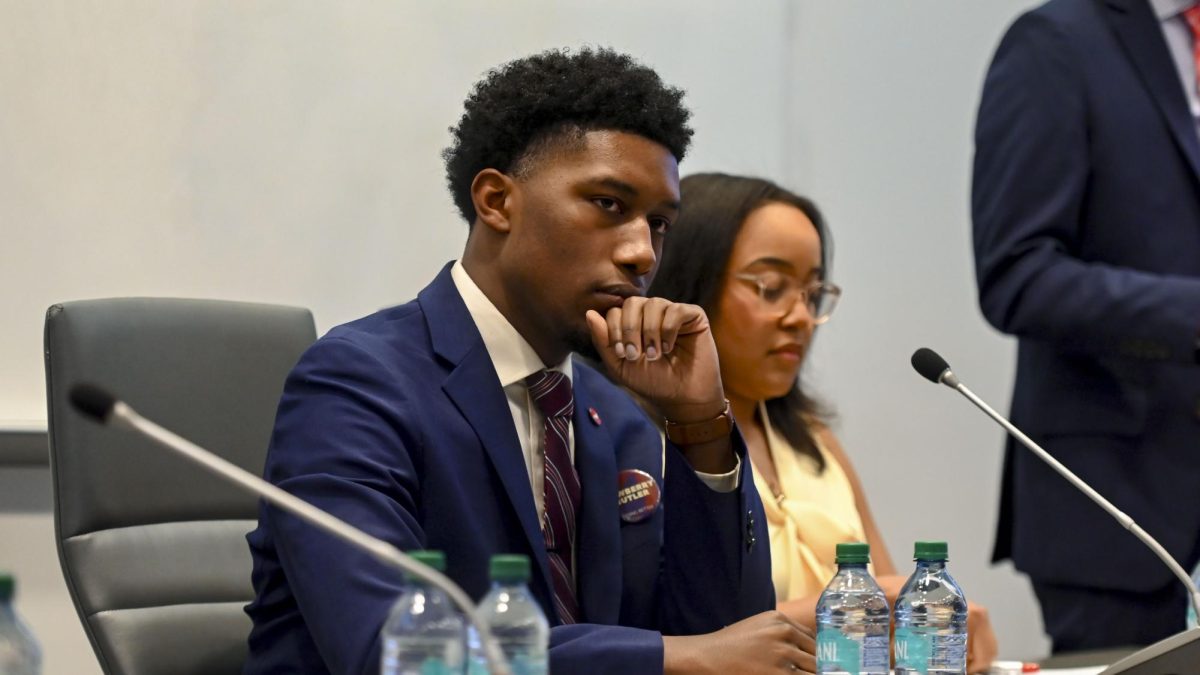
NC State’s Student Senate held its sine die meeting on March 25, which is the final meeting for the 105th session. Protestors from the Student for Justice of Palestine attended in support of Resolution 150 (R150), the Call for Support for Palestinian Students Act.
R150 succeeds Resolution 29 (R29), the Call for a Permanent Ceasefire Act, which failed to pass in the 104th Session.
Both legislations aimed to support Palestinian students, with the key difference being that R29 pushed the university as a whole to adopt a stance against the genocide in Gaza, while R150 does not.
“North Carolina State University is urged to discontinue the ‘Cultural Treasures of Israel & Jordan’ WolfTreks trip for overlooking the occupation of Palestinian territories and disregarding Palestinian students’ sentiments,” corresponding Senator Naila Din wrote of R29 at the time.
R29 passed the Senate, but then Student Body President Allison Markert vetoed it.
In the period after R29 failed to pass, SJP reported experiencing bullying, harassment and doxxing. Benjamin Pulgar-Guzman, a fourth-year PhD candidate in sociology, spoke during the 104th session in favor of passing R29 and said threatening letters were sent to NC State pertaining to him.
“Last time that I spoke here, I was contacted by North Carolina State [University] a couple of weeks after the fact because many letters were sent to NC State, hundreds of them, they seem to be AI-written, threatening the university and my name was included in those letters for the things that I said before you,” said Pulgar-Guzman.
Yasmine Arikat, the leader of NC State’s Students for Justice in Palestine, reported a similar experience. “In 2024, during the R29 resolution, Palestinians came to these chambers and spoke about losing our family, our cousins, our homes, our scholarships and our endless experiences as Palestinians on this campus. In response, we got laughed at, belittled, bullied, betrayed, doxxed, harassed and labeled as the aggressors.”
Despite this, Students for Justice in Palestine urged the Senate to pass R150.
“You don’t get to claim to represent everyone while ignoring the students who need you most,” said Arikat. “You don’t get to celebrate diversity while excluding Palestinian voices from your concern. People are watching, students are watching, and Palestinian students will remember exactly who stood with them and who didn’t. Do the right thing.”
“The resolution reaffirms a commitment that I know you all share with one another. It corrects university hypocrisies, and it also supports dialogue initiatives and interfaith cooperation,” Pulgar-Guzman said.
Juliette Majid, a graduate student in the Department of Chemistry, adds, “This body has the opportunity to correct history and commence the protections for Palestinian students at NC State.”
Some Jewish students were present and requested the Senators to make an amendment aimed to provide nuance to the genocide. Naomi Vargas, a third-year civil engineering and philosophy student, said, “I also ask that the education program outlined in the resolution be amended such that Israeli history and culture are included in the dialogue alongside Palestinian and Middle Eastern history and dialogue.”
After a break, senators discussed R150. Corresponding Senator Jana Sayyed stated that the legislation aims to support Palestinian students.
“Writing and submitting this legislation now specifically comes from conversations I’ve had with students over the past school year. Students who feel unsupported — who feel unsafe speaking up and feel like their experiences are being overlooked.”
No amendments were made and the Student Senate moved into a period of debate.
Senator Maheera Hassan, acting as a proxy for Senator Zainab Aleem, said that senators in support of R29 during the 104th session were also met with animosity.
“We spent so much time of that session in a deeply uncomfortable, hostile environment, often being told by somebody to get over it. That kind of response, especially when people’s identities were being targeted, is not something that can be dismissed or moved on from so easily.”
In her pro-debate, she continues to emphasize the importance of R150. “This legislation is incredibly important, given the track record of Student Government; it’s also necessary. It represents a chance to show a large portion of the student body that they are seen, supported and valued, and that their student government is willing to stand with them in meaningful ways.”
Senator Judson Avery also gave a pro-debate, stating that R150 reflects that the student body’s voice is being heard.
“I think what I’ve gathered from, just what we’ve heard from the community, is that there’s a community on campus really hurting right now. And I think even though we may not have the power to alleviate that, I think it’s important to acknowledge that so that our students feel like we’re hearing them.”
R150 passed 30-1-1.
In the wake of R150 passing the Student Senate, Majid described the experience to be healing. “Considering what happened last time, I found the experience to be somewhat healing. I did cry. It’s hard to go into these spaces again and again, having to tell our stories and re-traumatizing ourselves, list the names, the lives of the people we lost.”
When asked about their thoughts on having passed the first hurdle, Pulgar-Guzman clarified that R150 passing the Student Senate wasn’t the first obstacle in Students for Justice in Palestine’s efforts to liberate all communities.
“Sometimes, what is seen as merely one pass, one legislation and one hurdle, and the next hurdle, of course, is whether or not the President is going to veto it. It really is a lot of work behind it. And so, I view this merely as an extension of all the hard work that is cumulative by, again, all these amazing students.”
Both Majid and Pulgar-Guzman plan to continue fighting for Palestinian liberation from the community to the administrative level.
“You always hear the definition of insanity is doing the same thing over and over again, and expecting the outcome that you want, or the same outcome, or whatever outcome. In this case, I would rather be insane, or be thought of as insane, than ever stop wishing for a just and liberated world and for a free Palestine.”