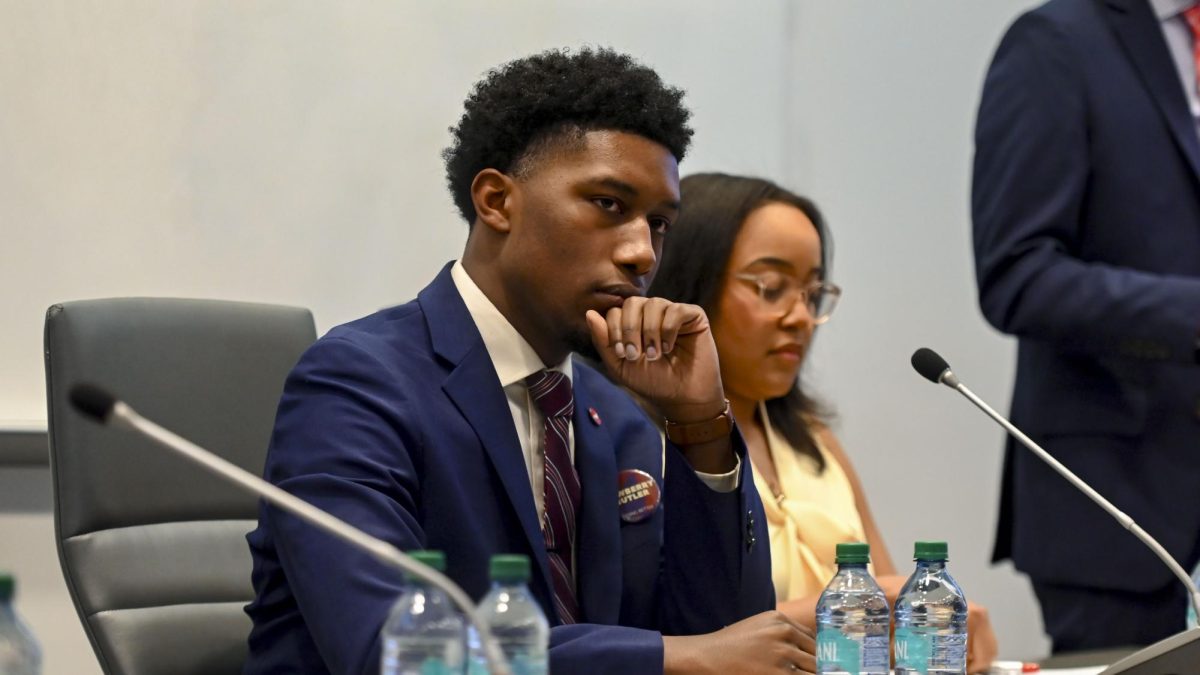
NC State Student Senate held its second-to-last meeting of the 105th session on March 11, 2026. During the meeting, they passed pieces of resolutions to establish a Student Dining Board and improve student disability resources and accommodations. Additionally, they tabled legislation developed in response to ICE activities on campus.
Resolution 121, short-titled the Student Dining Board Establishment Act, was proposed by corresponding Senator Mordecai Mengesteab and with Senator Kaleb Garcia and Senator Judson Avery as co-sponsors. When discussing why a Student Dining Board is needed, the legislation states: “informal and unsanctioned feedback channels can lead to miscommunication and unproductive discourse between students and dining administration.”
Furthermore, the legislation listed nine institutions that have Student Dining Boards, including Chapel Hill. Senator Mengesteab reported, “Preliminary conversations with dining have gone pretty well in terms of their openness to establishing this form of formal feedback channel.”
Mengesteab spoke about improving student participation in student dining.
“Formalized feedback channels between our students and our global dining would probably improve how we can actually advocate for students in terms of their opinions and preferences on how our dining works,” he said
R-121 outlines the Student Dining Board to be composed of members from Student Government, the Residence Hall Association, the Graduate Student Association, members of the student body, and administrators from dining and the university.
The Student Dining Board would be granted the power to give feedback on “dining budgets, meal plan structures, operating hours, menus, and service quality.”
The Secretary of the Student Affairs Committee Evie Shackles, reported that the committee mostly had pro-debates. “A lot of people mention this is a good way to get students more involved with dining, considering that’s the place where we all get our food.”
With no con-debates or questions, the legislation was passed 32-1-1.
Resolution 139, short-titled the Disability Resource Accommodation Improvement Act, was proposed by corresponding Senator Zainab Aleem with three co-sponsors. The improvements detailed in the legislation are in response to a Google Form the Diversity, Equity and Inclusion (DEI) Senate Committee sent to students during the 103rd session.
Improvements include adding sensory rooms in Talley Student Union, allowing students to opt-in to construction, establishing a disability resource training program for faculty and more. Senator Aleem, who also serves as the Chair of the DEI Committee, reported that the committee was in favor of the legislation.
With no questions, the Senate moved to a debate period.
During the debate period, co-sponsor Senator Jonathan Falso said they met with Vice Provost for Equal Opportunity Sheri Schwab.
“It was a very positive meeting. And overall, I think it’s much — needed stuff and a good first step and something to lay down the groundwork for future sessions if they want to work on some more stuff for helping DRO students.”
Senator Mengesteab offered a pro-debate, pointing out how students with disabilities are a forgotten part of DEI.
“We talk a lot about other groups, but I’m glad that we’re taking steps to protect students with disabilities. And this legislation is very comprehensive and is a good step.”
Senator Patrick Law Jr. echoed Senator Mengesteab’s pro-debate.
“Adding on to what everyone said, I think this bill addressed a lot of things that are forgotten with regards to DEI. It is very thorough and very needed.”
The Disability Resource Accommodation Improvement Act passed 36-0-0.
Resolution 130, short-titled The Say Their Names Act, was proposed by Senator Liam Barry and co-sponsored by 20 senators. The legislation was made in response to ICE activities in North Carolina and to stand in solidarity with Minnesota citizens.
If passed, the Student Senate will work with the Student Body Treasurer to create “red cards,” which will showcase constitutional rights in English and Spanish. These would be distributed to students, faculty and staff members of NC State.
Additionally, the Student Senate would provide a video script to the NC State Student Government Director of Communications, which will inform students, faculty and staff of what to do if ICE is present on campus.
At present, the legislation has been tabled indefinitely by Senator Barry.
In email correspondence, he said, “With spring break right around the corner and then the end of the session shortly after, we know that R-130 would not get the necessary attention that it deserves.”
Currently, Senator Barry and his co-sponsors intend to reintroduce the bill during the 106th session, which will begin on April 8, 2026.